
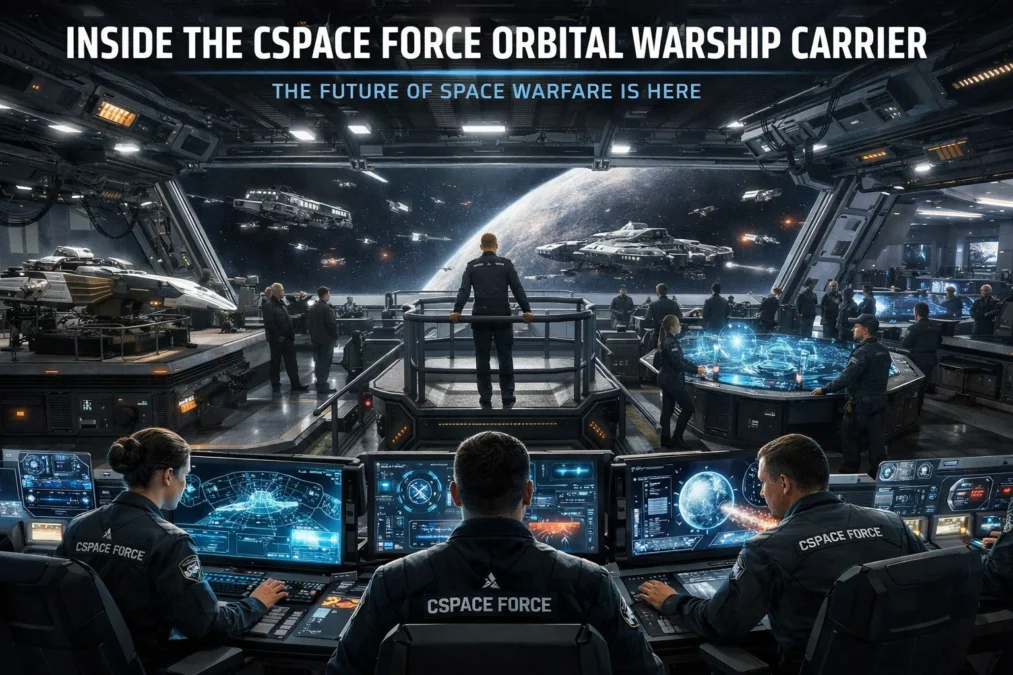

The idea of a cspace force orbital warship carrier captures the imagination like few other concepts in modern defense strategy. It represents the next evolution of military dominance—extending power projection beyond Earth’s atmosphere into orbital and deep-space environments. As nations invest heavily in space defense infrastructure, this concept is rapidly transitioning from speculative fiction to a plausible strategic reality.
In this comprehensive guide, we explore what a cspace force orbital warship carrier actually is, how it might function, why it matters, and how it could reshape global security. Whether you’re a defense enthusiast, strategist, or curious reader, this article delivers a clear and authoritative breakdown of this futuristic yet increasingly relevant topic.
What Is a CSpace Force Orbital Warship Carrier
A cspace force orbital warship carrier is a large, advanced space-based military platform designed to deploy, support, and command multiple smaller spacecraft or orbital weapons systems. Much like naval aircraft carriers dominate oceans, this concept centers on controlling strategic zones in orbit, enabling rapid deployment of defense or offensive capabilities across space domains.
Unlike traditional satellites, a cspace force orbital warship carrier would be modular, heavily fortified, and equipped with propulsion systems for maneuverability. It would serve as both a command hub and a logistical backbone, supporting missions such as surveillance, interception, defense shielding, and potentially orbital combat operations.
The Strategic Importance of Orbital Warship Carriers
The emergence of the cspace force orbital warship carrier signals a shift in military doctrine from terrestrial dominance to multi-domain warfare. Space is no longer just a support layer for communications and GPS—it is becoming a contested environment where strategic superiority can determine outcomes on Earth.
By maintaining a cspace force orbital warship carrier in orbit, a nation gains persistent surveillance, rapid response capability, and the ability to protect or disrupt critical satellite networks. This creates a significant deterrence factor, as adversaries must account for a mobile and powerful presence beyond the atmosphere.
Core Technologies Behind Orbital Warship Carriers
A cspace force orbital warship carrier relies on a fusion of advanced technologies, including nuclear or high-efficiency propulsion systems, autonomous AI-based command frameworks, and directed-energy weapons. These systems must operate reliably in the harsh conditions of space, including radiation exposure and extreme temperature fluctuations.
Equally critical are docking systems, drone deployment bays, and defensive shielding mechanisms. The success of a cspace force orbital warship carrier depends on seamless integration between hardware and software, ensuring real-time responsiveness and mission adaptability in complex orbital environments.
Design and Structural Components
The architecture of a cspace force orbital warship carrier would likely resemble a hybrid between a space station and a heavily armed warship. It would feature reinforced hull structures, modular compartments, and expandable docking arms for hosting smaller spacecraft.
Internally, the design would prioritize redundancy, with multiple control centers, energy cores, and fail-safe systems. A well-designed cspace force orbital warship carrier ensures operational continuity even under attack or system failure, making resilience a defining feature of its structure.
Operational Capabilities and Mission Profiles
A cspace force orbital warship carrier is designed for multi-role operations, including reconnaissance, satellite defense, orbital interception, and force projection. It can deploy swarms of smaller drones or fighters to execute missions with precision and speed.
In high-conflict scenarios, the cspace force orbital warship carrier could serve as a command-and-control hub, coordinating space-based and ground-based assets. Its ability to maintain a constant orbital presence gives it a strategic advantage over static or single-purpose satellites.
Comparison with Traditional Military Assets
The transition from Earth-based systems to a cspace force orbital warship carrier represents a paradigm shift in military capability. Below is a structured comparison to highlight key differences.
| Feature | Orbital Warship Carrier | Naval Aircraft Carrier | Military Satellite |
|---|---|---|---|
| Mobility | High orbital maneuverability | Ocean-based mobility | Limited or fixed orbit |
| Role | Multi-domain command & combat | Air power projection | Communication & surveillance |
| Defense Systems | Advanced shielding & countermeasures | Missile defense systems | Minimal defensive capability |
| Deployment Speed | Instant global reach | Limited by geography | Passive presence |
| Strategic Impact | Space dominance | Regional dominance | Support function |
This comparison shows how a cspace force orbital warship carrier combines the strengths of multiple systems while overcoming their limitations, making it a uniquely powerful asset.
Challenges in Developing Orbital Warship Carriers
Despite its potential, building a cspace force orbital warship carrier presents immense technical and financial challenges. Launch costs, material constraints, and the complexity of maintaining long-term operations in space are significant hurdles that must be overcome.
There are also legal and ethical concerns surrounding the militarization of space. International treaties and geopolitical tensions could complicate the deployment of a cspace force orbital warship carrier, requiring careful navigation of global policy frameworks.
The Role of Artificial Intelligence and Automation
AI plays a critical role in the functionality of a cspace force orbital warship carrier, enabling autonomous navigation, threat detection, and real-time decision-making. Given the communication delays in space, onboard intelligence systems must operate independently with high reliability.
Automation also reduces the need for large human crews, improving efficiency and safety. A modern cspace force orbital warship carrier would likely rely heavily on machine learning algorithms to optimize performance and respond dynamically to evolving threats.
Future Trends and Strategic Outlook
As space becomes increasingly contested, the development of the cspace force orbital warship carrier is expected to accelerate. Nations are investing in reusable launch systems, advanced propulsion, and space-based defense platforms that could serve as building blocks for such carriers.
Industry experts suggest that the cspace force orbital warship carrier could become a central pillar of future military strategy. As one analyst noted, “Control of orbit will define the balance of power in the 21st century, just as control of the seas did in previous eras.”
Misconceptions About Orbital Warship Carriers
One common misconception is that a cspace force orbital warship carrier is purely a science fiction concept. In reality, many of its core technologies already exist or are in advanced stages of development, making it more plausible than it may seem.
Another misunderstanding is that such systems are purely offensive. In practice, a cspace force orbital warship carrier would likely play a significant defensive role, protecting critical infrastructure and ensuring the stability of space-based services.
Real-World Applications Beyond Warfare
While primarily a military concept, the cspace force orbital warship carrier could also support non-combat missions such as disaster monitoring, space debris management, and emergency satellite deployment. Its versatility makes it valuable beyond traditional defense roles.
This dual-use potential enhances the strategic value of a cspace force orbital warship carrier, allowing it to contribute to global stability while maintaining readiness for conflict scenarios.
Read More: Is This Real? CSpace Force Orbital Warship Carrier Could Change War Forever
Conclusion
The cspace force orbital warship carrier represents a bold step into the future of military strategy and space exploration. It combines advanced technology, strategic foresight, and multi-domain capability into a single, powerful platform that could redefine how nations secure their interests.
As development continues, the cspace force orbital warship carrier will likely move from concept to reality, shaping the next era of global power dynamics. Understanding its potential today offers valuable insight into the challenges and opportunities of tomorrow.
FAQ Section
What is a cspace force orbital warship carrier used for
A cspace force orbital warship carrier is used for deploying and managing space-based military assets, enabling surveillance, defense, and potential combat operations in orbit.
Is the cspace force orbital warship carrier real or theoretical
The cspace force orbital warship carrier is currently a conceptual system, but its underlying technologies are actively being developed and tested.
How does a cspace force orbital warship carrier differ from satellites
Unlike satellites, a cspace force orbital warship carrier is mobile, heavily armed, and capable of deploying multiple smaller spacecraft for various missions.
Which countries are developing cspace force orbital warship carrier concepts
Several major space powers are exploring technologies related to the cspace force orbital warship carrier, though specific programs are often classified.
What challenges limit the cspace force orbital warship carrier development
High costs, technical complexity, and international regulations are major barriers to building a cspace force orbital warship carrier.